Soviet football: a country behind the black spider
A goalkeeper in black they called a spider, the only one in history given the Ballon d'Or. The first European Championship, won in 1960, clubs backed by a factory, the army and the Lubyanka, and a game the whole country played.
The people's game number one
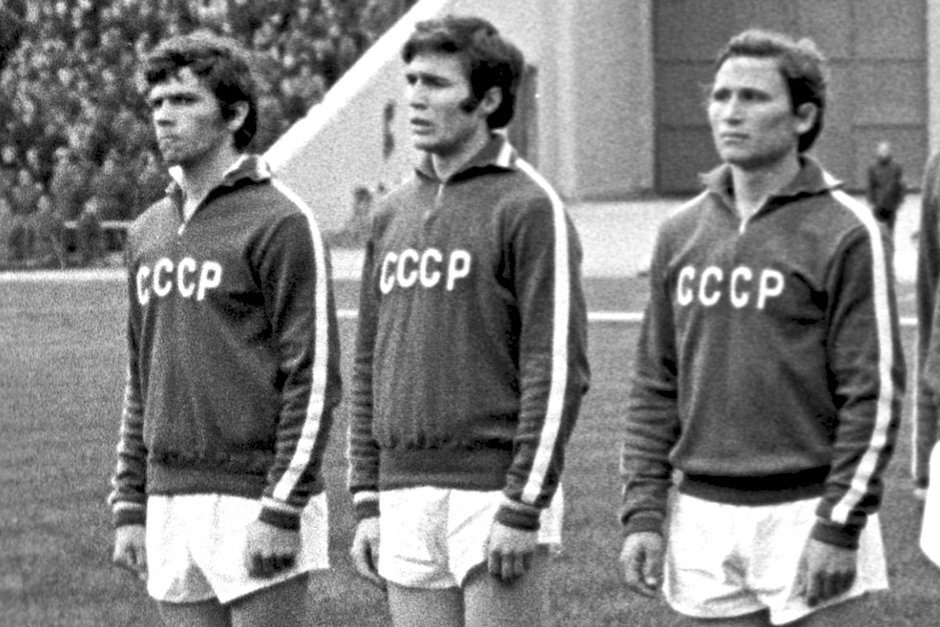
If hockey was the showcase the USSR displayed to the world, football was what the country actually played, every day and in every courtyard. It was the sport of first love and widest reach: millions of boys chased a ball on wastelands, in the evenings the whole country pressed against the television or radio, and the players' names were known as well as the cosmonauts'. And yet on the international stage Soviet football never rose to the height hockey reached: one great victory, several glorious defeats, and one goalkeeper who became a legend of the planet.
That goalkeeper was Lev Yashin, and he is the right place to begin, because he is the face of Soviet football in the world. To this day he remains the only goalkeeper in history to receive the Ballon d'Or, the prize for Europe's best footballer. For a game where the awards almost always go to forwards, that is the equivalent of a keeper scoring the winning goal in a final.
Lev Yashin: the black spider
Yashin did not come to football at once. At Moscow Dynamo, which he joined in 1950, he was at first a reserve and seriously thought of switching to ice hockey, where he even won a USSR Cup. The place in goal opened up in 1953, and Yashin held it for eighteen years, remaining a one-club man.
He changed the goalkeeper's craft itself. Before him, a keeper sat on his line and waited for the shot. Yashin played the whole penalty area: he came far off his line, commanded the defense, launched attacks with a precise throw of the hand, becoming in essence the first "sweeper-keeper." Add the signature style: all in black, calm, without fuss, with a cat's reflexes. Hence the nicknames: in the West the "black spider" or "black panther," at home simply Lev. Over his career he kept, by various counts, more than a hundred and fifty clean sheets and became a living proof that the Soviet school could do more than attack. In 1963 France Football gave him the Ballon d'Or, the only time in history the prize went to a goalkeeper. Half a century later, in 2019, France Football would establish an award for the world's best keeper and name it after Yashin.
1960: Europe taken
The USSR national team reached its peak at the very start of big European football. In 1960 the first European Championship in history was held (then the European Nations Cup), and the Soviet team won it. The path was doubly symbolic: in the quarterfinal, Franco's Spain refused to travel to Moscow for political reasons, and the USSR advanced without a game. And in the final in Paris on July 10, 1960, the team beat Yugoslavia 2 to 1 in extra time: trailing during the match, the Soviets equalized through Metreveli and snatched the win with Viktor Ponedelnik's goal in the added minutes. That team was coached by Gavriil Kachalin, captained by Igor Netto, with Yashin in goal. This trophy remained the national team's only major title in its entire history.
What followed were respectable results, but no gold. The Olympic gold of Melbourne in 1956 had come even before the European triumph. At the World Cups the best achievement was fourth place in England in 1966. At the Euros the USSR reached the final three more times (1964, 1972, 1988) and lost all three. The result was a reputation as a strong, respected but unlucky team: almost always near the summit and almost never on it.
A factory, the army and the Lubyanka
Club football in the USSR was arranged so that a ministry stood behind every big team, and this explains much about Soviet life. Dynamo was historically the sports society of the interior and security organs: it was no accident that Yashin, like many Dynamo men, was formally enrolled along that line, and the society was overseen by none other than the KGB and its predecessors. CSKA was the army's club, Lokomotiv the railwaymen's, Spartak grew out of the producers' cooperatives and trade unions and for exactly that reason became the "people's" team, supported in defiance of the bosses' clubs. Torpedo belonged to a car factory, Moscow's ZIL.
Behind these signboards stood real relations of power. Ministerial affiliation decided where a promising player would be conscripted and who would be covered in a disputed situation; the eternal rivalry of Spartak and Kyiv Dynamo, of the army men and the Dynamo men, was not only sporting. Kyiv Dynamo under Valery Lobanovsky in the 1970s and 1980s became almost a separate national team: its players formed the core of the national side, and Lobanovsky himself, with his "scientific" approach to football, became a figure of world stature. It was the Kyiv side that first among Soviet clubs won European trophies.
The game as part of life
For the ordinary person, football was not about geopolitics but about joy and belonging. Fan passion was one of the few areas where a Soviet person was allowed to feel openly, loudly and collectively: one could support one's club fiercely, argue oneself hoarse, hate the rival, and none of it counted as sedition. In a country where emotions were more often kept to oneself, the stadium was a lawful outlet.
Football saturated the culture too. The whole country knew its idols: besides Yashin, there was the striker Eduard Streltsov, whose brilliant career was broken by arrest and a labor camp at the height of his fame, something spoken of in the USSR only in low voices. There were songs, films, famous radio broadcasts, courtyard teams and stickers. The domestic championship lived a full-blooded life of its own, regardless of how the national team fared. Football was the fabric of daily life that joined millions of strangers in a shared experience, and in that sense it gave the country more than any titles.
The legacy
With the dissolution of the USSR, the single great school dispersed across fifteen countries, and common Soviet football ended just as the hockey "Red Machine" did, scattering across new borders. But its traces did not vanish. Yashin remains on the lists of the century's greatest players and the only goalkeeper with a Ballon d'Or; Lobanovsky's methods are studied by coaches around the world; and the victory of 1960 still stands in history as the moment a Soviet team was the first in Europe.
Soviet football has a verdict of its own, without the double bottom typical of more ideological subjects. It is not a story of the system's triumph or of its crimes, but simply the story of a great popular passion: a country that loved the game more than it knew how to win it, and that gave the world one of the greatest goalkeepers of all time. Sometimes the most human thing in a country's history is precisely the way it played ball.
Frequently asked questions
Who was Lev Yashin? The legendary Soviet goalkeeper of Moscow Dynamo and the USSR national team, the only keeper in history to win the Ballon d'Or (1963). His nicknames were the "black spider" and "black panther." He is considered one of the greatest goalkeepers of all time.
What did the USSR national football team achieve? Its main title was victory at the first European Championship in 1960. Plus Olympic gold in 1956 and fourth place at the 1966 World Cup. The USSR reached the Euro final three more times (1964, 1972, 1988).
What were the clubs Dynamo, CSKA and Spartak? The leading Soviet clubs, each with its ministry: Dynamo tied to the interior and security organs, CSKA the army's club, Spartak grown from the trade unions and considered the "people's" team.
Why is Spartak called the people's team? Because, unlike the ministerial Dynamo (the organs) and CSKA (the army), Spartak grew out of producers' cooperatives and trade unions and had no "power" patron, for which fans loved it especially.
Who was Valery Lobanovsky? The coach of Kyiv Dynamo, who turned the club into a world-class force with a "scientific" approach to football. Kyiv Dynamo was the first Soviet club to win European trophies.
Why was Soviet football not as successful as hockey? The national team had only one major title (Euro 1960) with several lost finals. The reasons are disputed, but the fact remains: in football the USSR was a strong and respected but unlucky team.
Related
- Soviet hockey: the sport where the USSR had far more gold.
- The 1980 Moscow Olympics: the home Games, of which the football tournament was a part.
- The KGB: the ministry behind the Dynamo sports society.
- Soviet cars: the factories that owned clubs like Torpedo.
Sources
The facts in this article can be verified against authoritative sources:
- Encyclopaedia Britannica, "Lev Yashin": https://www.britannica.com/biography/Lev-Ivanovich-Yashin
- Wikipedia, "Lev Yashin": https://en.wikipedia.org/wiki/Lev_Yashin
- BBC Sport, "Euro 1960: Lev Yashin leads Soviets to glory in France": https://feeds.bbci.co.uk/sport/football/17680769
- Football Heritage, "Soviet Football": https://www.footballheritage.co.uk/soviet-football
- Russian Football News, "Lev Yashin: The Black Panther Who Changed the Goalkeeper Position": https://russianfootballnews.com/lev-yashin-the-black-panther-who-changed-the-goalkeeper-position/
Assessments of the reasons for the national team's international failures differ; we give the undisputed facts and note that the explanations remain a matter of debate.