The dissolution of the USSR: how a superpower vanished in 1991
In December 1991 the Soviet Union ceased to exist, breaking apart into 15 states. Why it happened, the role of perestroika, the coup and the Belovezha Accords — and why it is still debated.
The end of a superpower
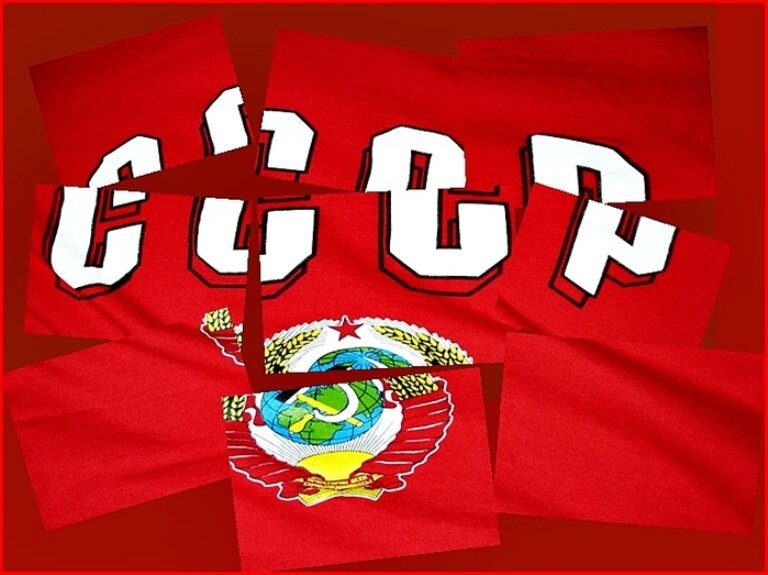
On 26 December 1991 the Soviet Union officially ceased to exist. A country that for almost 70 years had been one of the world's two superpowers broke apart into 15 independent states — from Estonia to Kazakhstan.
It was one of the great events of the 20th century. It ended the Cold War, redrew the map of the world and shaped the fate of hundreds of millions of people. But none of it happened in a single day: the collapse had been building for years and was the result of many causes whose relative importance historians still dispute.
Why the system was faltering
By the early 1980s the Soviet Union faced deep problems.
- The economy was losing momentum. The planned system struggled to produce goods for ordinary people; shortages grew, and it fell behind the West in quality and technology. The long years of late "stagnation" brought no reform.
- The arms race drained the country. Enormous spending on defence and rivalry with the United States were an unbearable burden on the budget.
- Drawn-out conflicts. The war in Afghanistan (1979–1989) cost money, lives and prestige.
The system held, but its margin of safety was wearing thin. Change was needed — and in 1985 a man came to power who was willing to attempt it.
Gorbachev: perestroika and glasnost
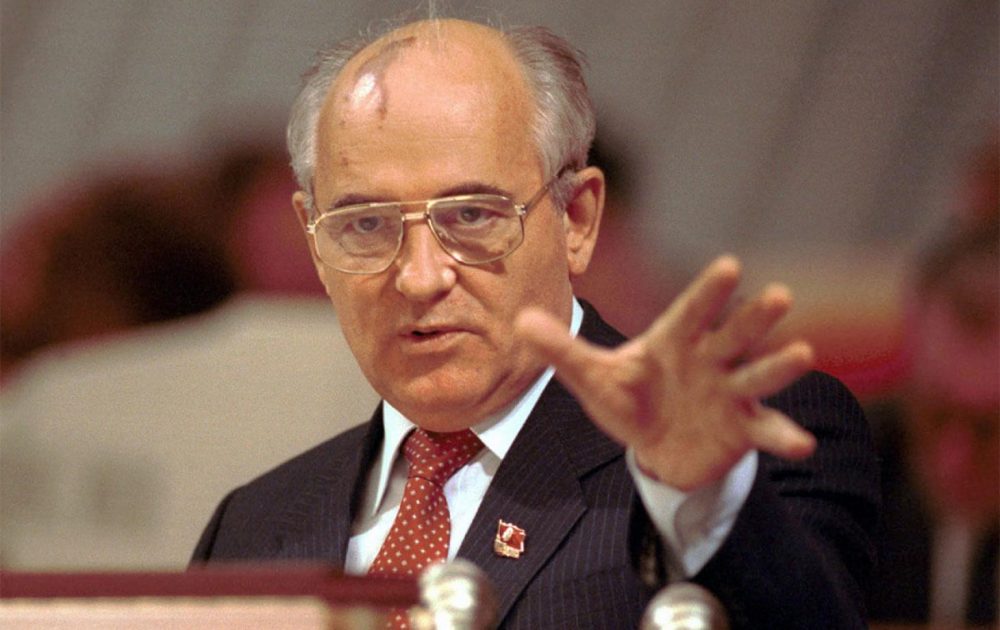
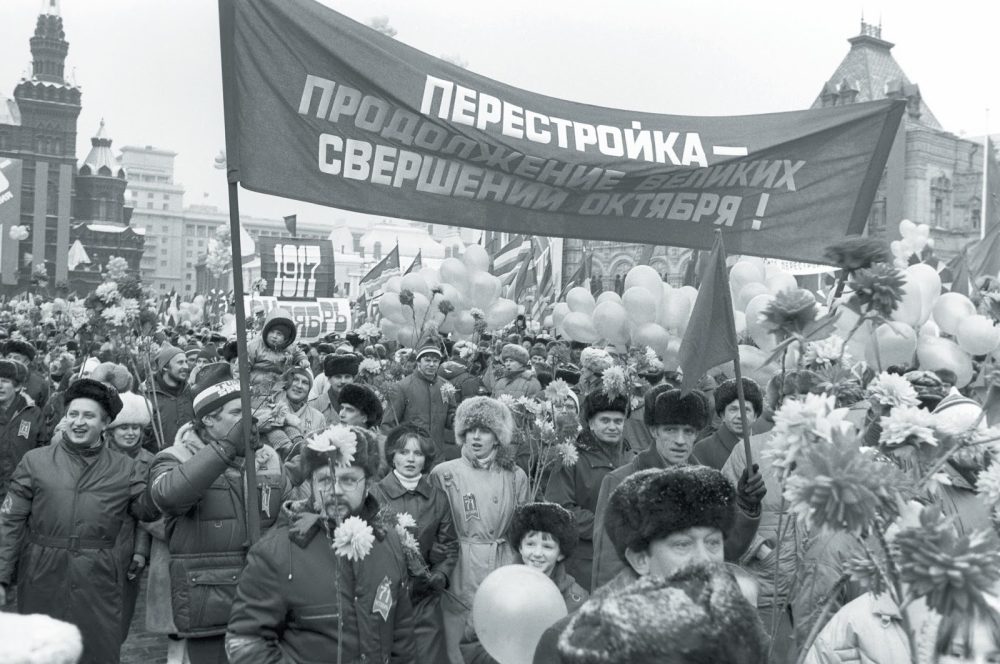
In 1985 Mikhail Gorbachev became leader of the Soviet Union. He launched two great reforms: perestroika (a restructuring of the economy and administration) and glasnost (openness, an easing of censorship).
Glasnost made it possible to speak of what had once been silenced: problems, past crimes, the failings of those in power. A freer press appeared, and debate began. Perestroika tried to revive the economy by allowing elements of a market — but in practice it often only deepened the chaos: the old system was already breaking down while the new one did not yet work, and shortages grew worse.
The reforms were meant to renew and save the Soviet order. But they had an unexpected effect: they weakened the rigid central power on which the Union rested. As fear and censorship receded, everything that had once been held down by force came into the open — including the republics' desire for independence.
Cracks: the republics and nationalism
The USSR was made up of 15 union republics, each the homeland of its own people. As the centre weakened, national movements rose in the republics.
A "parade of sovereignties" began. Estonia was the first to declare sovereignty (November 1988), and others followed. In March 1990 Lithuania became the first to declare full independence.
At the same time, Soviet control over Eastern Europe was collapsing: in 1989 the Berlin Wall fell, and the communist governments of the Soviet bloc departed one after another. Within Russia itself, Boris Yeltsin was gaining strength: in June 1991 he was elected president of the Russian republic — for the first time by a nationwide vote.
Gorbachev tried to hold the country together by preparing a new Union Treaty that would have given the republics far more autonomy. It was precisely the attempt to stop this treaty from being signed that set off the decisive events.
The August coup of 1991
On 19 August 1991 a group of senior officials — the vice president, the head of the KGB, the defence minister and others — tried to seize power in order to stop the reforms and preserve the old Union. They formed the "GKChP" (the State Committee on the State of Emergency), isolated Gorbachev while he was on holiday in Crimea, and declared a state of emergency. Tanks rolled onto the streets of Moscow.
But the coup failed. The centre of resistance was the "White House" — the building of the Russian parliament. Boris Yeltsin climbed atop a tank in front of it, called the coup illegal and appealed for resistance. Thousands came out to defend the White House and built barricades; the troops refused to storm it, and some of the military went over to the defenders' side. After three days, on 21 August, the coup collapsed and its organizers were arrested.
The consequences were decisive. The coup, meant to save the Union, only hastened its end: it fatally undermined the authority of Gorbachev and the central government. The Communist Party was removed from power, and after this the republics began declaring independence one after another.
The Belovezha Accords
In the autumn of 1991 the collapse accelerated. On 1 December a referendum was held in Ukraine: about 92% of those who voted chose independence. This effectively decided the fate of the Union — without Ukraine it was impossible.
On 8 December 1991 the leaders of three republics — Russia (Boris Yeltsin), Ukraine (Leonid Kravchuk) and Belarus (Stanislav Shushkevich) — met in the Belovezha Forest and signed the Belovezha Accords. They declared that the USSR "was ceasing to exist." The 1922 treaty that had created the Union was declared void, and in place of the USSR the Commonwealth of Independent States (CIS) was created. Gorbachev was not invited to the meeting.
By the participants' own account, they sought to carry out the "divorce" peacefully and by agreement — to avoid a bloody breakup like Yugoslavia's. On 21 December, in Alma-Ata, several more republics joined the agreement.
25 December: the flag comes down
On 25 December 1991 Mikhail Gorbachev appeared on television and announced his resignation as president of the USSR — president of a country that in effect no longer existed. In his farewell speech he said that the Cold War was over. That same evening the red flag of the Soviet Union was lowered over the Kremlin for the last time, and the Russian tricolour was raised.
Formally the Union ceased to exist the next day — 26 December 1991, when the upper house of the Supreme Soviet of the USSR recognized this and voted itself out of existence. Russia became the successor state to the USSR, taking its place at the United Nations.
What came next
In place of the Soviet Union, 15 independent states emerged. For some this meant winning freedom and their own statehood; for others it was the start of hard years.
The 1990s brought the former republics economic shock: a collapse in production, hyperinflation and the impoverishment of many people. Russia lost its superpower status. At the same time came freedom of speech, private property and an openness to the world that had not existed before.
Contested assessments
Two great debates surround the collapse of the USSR, and we show both sides.
Why did it happen? There is no single view. Some historians put the failure of the economy first, others the national movements, others Gorbachev's reforms that weakened the centre, others the pressure of the Cold War, and still others the role of particular people (Gorbachev, Yeltsin) and of chance. Most likely all of it came together at once.
Was it good or bad? Here too opinions diverge. Some mourn the collapse as the loss of a great country; in Russia it was later called the greatest geopolitical catastrophe of the century. Others — including the signatories of Belovezha themselves — hold that a totalitarian order was dismantled peacefully and that peoples gained their independence. There is also argument over whether the three leaders had the right to dissolve the Union. We do not choose one verdict for the reader.
Frequently asked questions
When exactly did the USSR collapse? The symbolic end is usually given as 25 December 1991 — Gorbachev's resignation and the lowering of the flag. Legally, the Union ceased to exist on 26 December 1991.
How many countries emerged? Fifteen — the number of former union republics.
Could the USSR have been saved? Historians disagree. Gorbachev tried to the end to preserve a renewed, freer Union through a new treaty. Many believe that without the August coup some form of union might have survived; others are convinced the collapse was already inevitable.
Related
- The founding of the USSR (1922) — how the Union that fell apart in 1991 was created.
- Chernobyl: the worst nuclear accident — the disaster that undermined trust in the government during perestroika.
- Shortages and queues — the economic problems that were shaking the system.
- The KGB: sword and shield of Soviet power — its chairman's coup finished the Union off.
- The hammer and sickle: the USSR's main symbol — the other half of the country's visual formula.
Sources
The facts in this article can be verified against authoritative sources:
- Encyclopædia Britannica, "Collapse of the Soviet Union": https://www.britannica.com/event/the-collapse-of-the-Soviet-Union
- Encyclopædia Britannica, "1991 Soviet coup attempt": https://www.britannica.com/topic/1991-Soviet-coup-attempt
- Wikipedia, "Dissolution of the Soviet Union": https://en.wikipedia.org/wiki/Dissolution_of_the_Soviet_Union
- Wikipedia, "Belovezha Accords": https://en.wikipedia.org/wiki/Belovezha_Accords
- The Moscow Times, "The Agreement That Ended the Soviet Union": https://www.themoscowtimes.com/2016/12/07/history-in-the-making-the-agreement-that-ended-the-soviet-union-a56456
Where the data are contested (the causes of the collapse and its assessment), we give different positions rather than a single one.