Shortages and queues: how Soviet retail worked
Shortages and queues are among the defining memories of Soviet daily life. Why everyday goods were often impossible to buy, how people coped — and what was cheap and guaranteed.
What "defitsit" meant
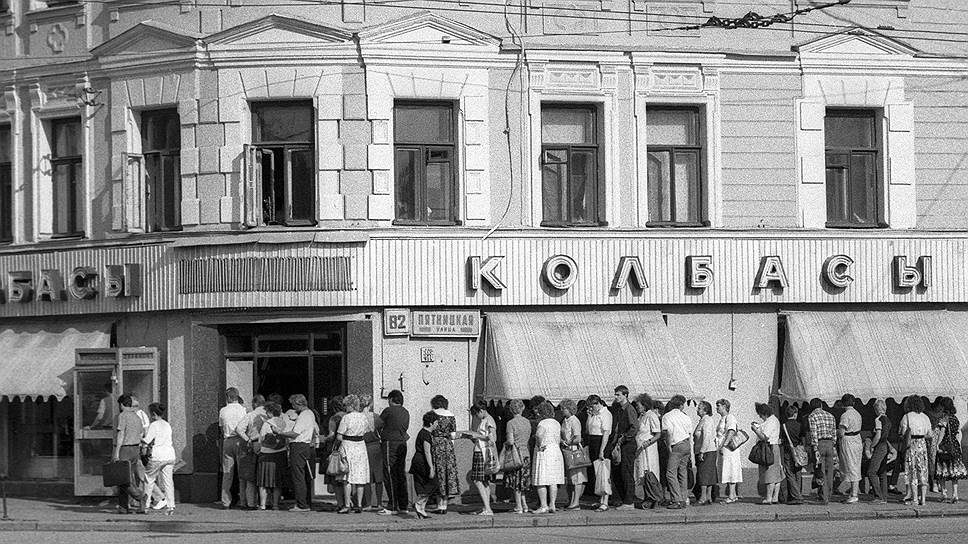
"Defitsit" (shortage) was the Soviet word for the constant lack of goods: the thing you needed — from fashionable shoes to sausage — often simply could not be bought, even when you had the money. The verb "to obtain" (dostat'), rather than "to buy," became one of the key words of Soviet life.
Shortages came with queues. Long lines formed for scarce goods; sometimes people joined a queue without even knowing what had been "thrown out" (that is, put on sale). Buying ordinary things could take hours.
Why it happened
The main reason was the design of the planned economy itself.
- The state set prices and kept them almost unchanged. When demand exceeded supply, the price did not rise (as it would in a market) — instead a shortage and a queue appeared.
- Planning priorities. Resources went above all to heavy industry and defence, while the production of goods for ordinary people was often a lower priority.
- Rigidity and breakdowns. Factories fulfilled the plan "by volume," responding poorly to real demand; both quality and variety suffered.
The Hungarian economist János Kornai described this as the "economics of shortage" — not an accidental failure, but a built-in feature of such a system.
How people coped
People adapted and showed real ingenuity.
- "Blat" — useful connections. Through the right people you could "obtain" what the shops did not have.
- The "avoska" — a string bag carried just in case: in case something turned up somewhere.
- Stockpiling. When a scarce good appeared, people tried to buy plenty of it for the future.
- Coupons. In hard times, especially in the late 1980s, ration coupons were introduced for certain goods — sugar, and sometimes meat.
There were also closed distributors for officials, and a "black market" where scarce goods could be bought at higher prices.
Two sides
Here, as with other topics, honesty matters.
On the one hand, basic things were cheap and guaranteed: bread, housing, transport and utilities cost almost nothing, and everyone had a job. For many people this was an important safety net.
On the other hand, the choice and availability of goods were poor: people queued for ordinary items, waited years for a car or a flat, and quality and variety lagged behind. Critics see the shortages as clear proof that the planned economy served the ordinary consumer badly.
Both sides existed at the same time — and we show both.
Related
- Khrushchyovki: how the country got its own flats — housing as part of Soviet daily life and its queues.
- Chernobyl: the worst nuclear accident — another side of the late-Soviet system.
- The kommunalka: life behind a shared door — crowding as the other constant of daily life.
- The Soviet dry law — sugar rationing opened the ration card era.
- The dacha: six hundred square meters that fed a country — the country's quiet answer to empty shelves.
Sources
The facts in this article can be verified against these sources:
- Wikipedia, "Shortage economy": https://en.wikipedia.org/wiki/Shortage_economy
- János Kornai, "Economics of Shortage" (1980) — the foundational academic study of the shortage economy.
- Cambridge Journal of Economics (Oxford Academic), "János Kornai: economics, methodology and policy": https://academic.oup.com/cje/article/45/2/371/6067266
Where economists disagree about the causes (rigid prices versus the design of the planned system itself), we note the different explanations.