The Cold War: half a century of superpower confrontation
For almost half a century the US and the USSR teetered on the edge of war without ever fighting each other directly. The arms race, space, the Berlin Wall, proxy wars and nuclear fear — a full account of the Cold War.
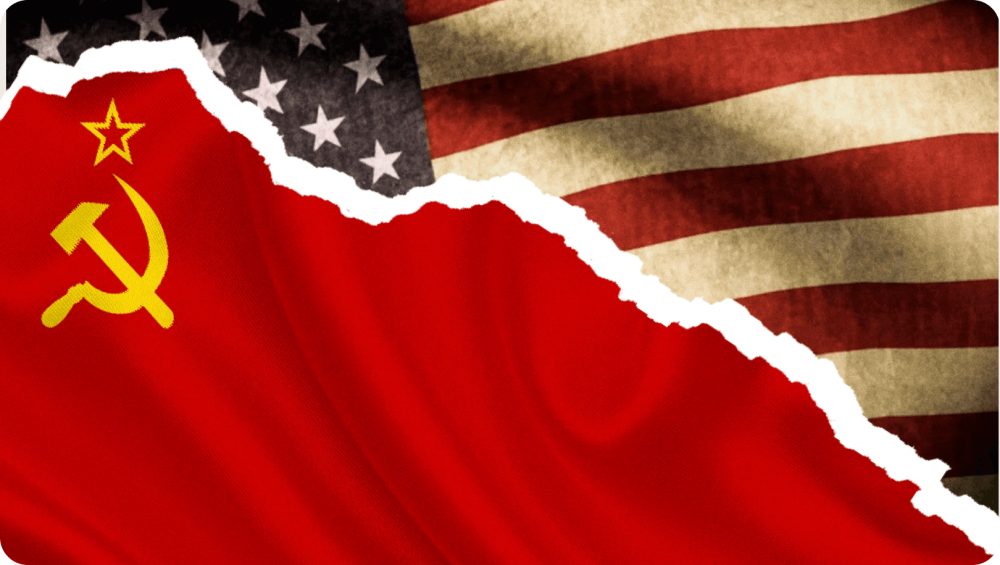
What the Cold War was
The Cold War was the confrontation between two superpowers, the US and the USSR, and their allies, lasting from the late 1940s until 1991. It is called "cold" because the two countries never fought a direct, all-out war against each other. Instead they competed in other ways: through military alliances, propaganda, espionage, economic aid, an arms race, space, and "other people's" wars in third countries.
At its heart it was a clash between two incompatible visions of the world — Western-style capitalism and democracy against Soviet-style communism. Each side believed its own order was the only right one and sought to expand its influence. And over all of it hung the atomic bomb, which made a direct war suicidal for both sides.
How it began
In the Second World War the US and the USSR were allies against Nazism. But as soon as the common enemy was defeated, deep contradictions came to the surface.
Already at the Yalta and Potsdam conferences (1945) it was clear that the victors saw Europe's future very differently. The USSR occupied Eastern Europe and within a few years installed communist governments under its control there. Europe was divided — in 1946 Winston Churchill called this line an "Iron Curtain": "from Stettin in the Baltic to Trieste in the Adriatic."
The West responded with a policy of containment — preventing the spread of communism. In 1947 US President Harry Truman proclaimed the "Truman Doctrine" and allocated aid to Greece and Turkey. It was followed by the Marshall Plan — about $13 billion to rebuild Western Europe, so that poverty and ruin would not push it toward communism. The world quickly split into two camps.
The division of Europe
The first major clash came over Berlin. The city, like all of Germany, was divided into zones. In 1948–1949 the USSR cut off the land routes into the western part of Berlin — and the West responded with an unprecedented airlift, supplying the city by air for almost a year. Direct war was avoided, but Germany split into two states — West Germany (FRG) and East Germany (GDR).
Military blocs also took shape: NATO (the Western alliance) was formed in 1949, and the Warsaw Pact (the Soviet-led alliance) in 1955. In that same year, 1949, the Soviet Union tested its atomic bomb — and the US nuclear monopoly was over.
The arms race and nuclear fear
The defining feature of the Cold War was the arms race. Both sides stockpiled ever more powerful nuclear weapons and the means to deliver them — bombers, missiles, submarines.
A frightening logic took hold, known as "mutually assured destruction": any nuclear strike would inevitably trigger a retaliatory one, and both sides would perish. The paradox is that this very horror kept the powers from direct war — fighting directly had become pointless. But the price was constant fear: for decades humanity lived under the threat of nuclear catastrophe, with militaries keeping their weapons ready to launch at a moment's notice.
Space as another front
The rivalry reached beyond the Earth too. The launch of the Soviet Sputnik 1 in 1957 shocked the US: it turned out that the USSR could put a craft into orbit — and therefore deliver a warhead across the ocean. The space race began. Yuri Gagarin's flight in 1961 was a new Soviet triumph. Space was not only science but a showcase: every success was meant to prove the superiority of one's own system.
Wars without a direct clash
Without fighting each other directly, the superpowers clashed in "other people's" countries — these are called proxy wars. Each backed "its" side with weapons, money and advisers.
- The Korean War (1950–1953) — split Korea into North and South and ended, in effect, in a draw.
- The Vietnam War (1955–1975) — a heavy defeat for the US.
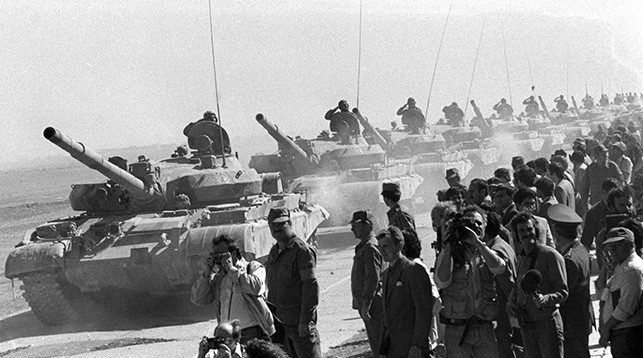
- The war in Afghanistan (1979–1989) — the "Soviet Vietnam," which cost the USSR about 15,000 lives and enormous sums.
The USSR also had to hold its own bloc together by force: in 1956 Soviet tanks crushed the uprising in Hungary, and in 1968 the "Prague Spring" in Czechoslovakia. This showed that the communist regimes of Eastern Europe rested largely on coercion.
The Berlin Wall
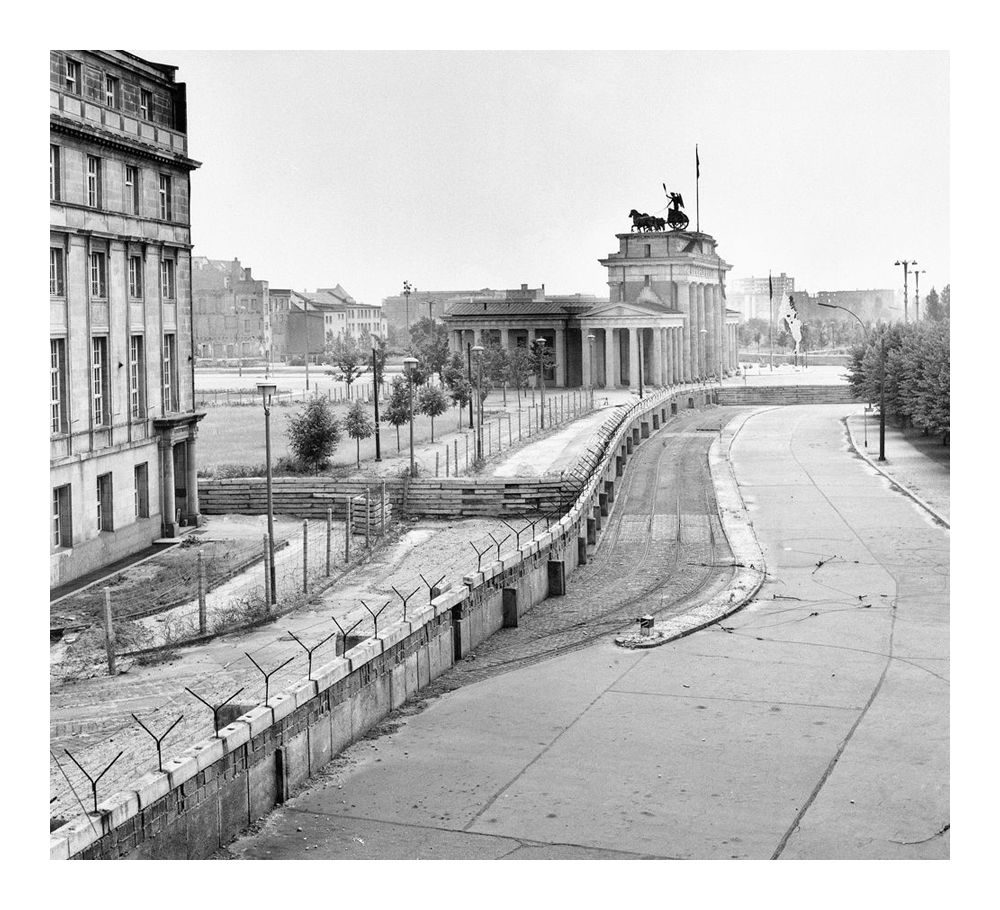
The symbol of a divided world was the Berlin Wall. Through the open border, residents of East Germany fled to West Berlin — about 3.5 million people by 1961, one in five citizens. To stop the exodus, the wall was thrown up literally overnight in August 1961. It stood for 28 years and became the chief visible image of the "Iron Curtain."
On the brink: the Cuban Missile Crisis
The most dangerous moment of the Cold War came in October 1962. Because of the deployment of Soviet nuclear missiles in Cuba, the world came closer to nuclear war than ever before. The crisis was resolved — but it showed how thin the line was between deterrence and catastrophe. (More on this in a separate article.)
Détente
In the 1970s tensions eased — a period known as détente. The superpowers signed treaties limiting nuclear arms, and the US established diplomatic contacts with China (1972). Détente showed something important: even enemies can agree on rules of restraint. The Cold War was not only chaos — it also produced a strange "discipline of survival" under nuclear fear.
A second round and Reagan
In the late 1970s tensions rose again — a period sometimes called the "Second Cold War," especially after Soviet troops entered Afghanistan. Ronald Reagan, who came to power in the US in 1981, sharply increased military strength and announced a space-based missile-defence programme.
But negotiations went on in parallel. At the Reykjavik summit (1986) Reagan and Soviet leader Mikhail Gorbachev came close to agreeing to abolish nuclear weapons. And in 1987 they signed a treaty eliminating intermediate-range missiles — for the first time an entire class of nuclear weapons was not merely limited but destroyed. At the same time both sides acknowledged that "a nuclear war cannot be won and must never be fought."
How it ended
The resolution came through Gorbachev. His reforms — perestroika and glasnost — and his "new thinking" in foreign policy changed the very logic of the confrontation. The decisive step was his decision not to use the Soviet army to keep the communist regimes of Eastern Europe in power.
And in 1989 those regimes fell one after another — in Poland, Hungary, Czechoslovakia, Romania, Bulgaria and East Germany. The climax was the fall of the Berlin Wall on 9 November 1989 — the image of the Cold War's end. And in 1991 the Soviet Union itself broke apart, and the confrontation ended for good.
Who won, and at what cost
The winners are usually considered to be the US and its NATO allies: the Soviet order collapsed while the Western one endured. But this victory came at a high price. The arms race and the wars cost trillions of dollars; the proxy conflicts claimed millions of lives in third countries; for decades the world lived under the threat of nuclear annihilation. And Russia's later return to great-power politics has shown that the simple formula "the West won for good" does not describe everything.
The historians' debate
Historians still argue over who was to blame for the Cold War — and we show the different positions.
- Some ("traditionalists") blame above all Soviet expansion and the USSR's drive to spread its system.
- Others ("revisionists") emphasize the role of the US — economic interests and "atomic diplomacy."
- Still others ("post-revisionists") see the main cause in the "security dilemma": both sides acted out of understandable fear, distrusted each other and read the other's moves as a threat.
Most likely ideology, interests and mutual distrust all played their part at once.
Frequently asked questions
Why is it called a "cold" war? Because the two superpowers never once fought a direct, all-out war against each other. They competed through alliances, an arms race, propaganda and wars in third countries.
When did it begin and end? It is usually dated from 1945–1947, and its end is taken to be the collapse of the USSR in 1991. The symbolic turning point is the fall of the Berlin Wall in 1989.
Could it have turned into a nuclear war? Yes, the risk was real. The world came closest to it during the Cuban Missile Crisis of 1962.
Who won? The West is generally considered the winner: the Soviet order fell apart. But the price was enormous, and the outcome less clear-cut than it seems.
Related
- On the brink: the Cuban Missile Crisis (1962) — the most dangerous moment of the Cold War.
- Sputnik 1: the start of the space age — the start of the space race.
- Yuri Gagarin: the first human in space — another milestone of the space rivalry.
- The dissolution of the USSR (1991) — the event that ended the Cold War.
- The KGB: sword and shield of Soviet power — the invisible front of the standoff with the CIA.
- The Berlin Wall: 28 years of the Cold War's greatest symbol — the Iron Curtain you could touch.
- The Great Patriotic War — the victory out of which the confrontation grew.
Sources
The facts in this article can be verified against authoritative sources:
- Encyclopædia Britannica, "Truman Doctrine": https://www.britannica.com/event/Truman-Doctrine
- Wikipedia, "Cold War": https://en.wikipedia.org/wiki/Cold_War
- Truman Library & Museum (US National Archives), "The Marshall Plan and the Cold War": https://www.trumanlibrary.gov/education/presidential-inquiries/marshall-plan-and-cold-war
- Council on Foreign Relations, "U.S.-Russia Nuclear Arms Control": https://www.cfr.org/articles/us-russia-nuclear-arms-control
- PBS American Experience, "The Start of the Cold War": https://www.pbs.org/wgbh/americanexperience/features/nuremberg-cold-war/
Where the data are contested (who was to blame for the start of the Cold War, and who "won" it and with what result), we give different positions rather than a single one.