Vladimir Kuts in Melbourne: The Olympic Distance Double of 1956
Kuts’s Melbourne finals, his rivalry with Gordon Pirie, the qualifying heat and the distinction between Olympic and world records.
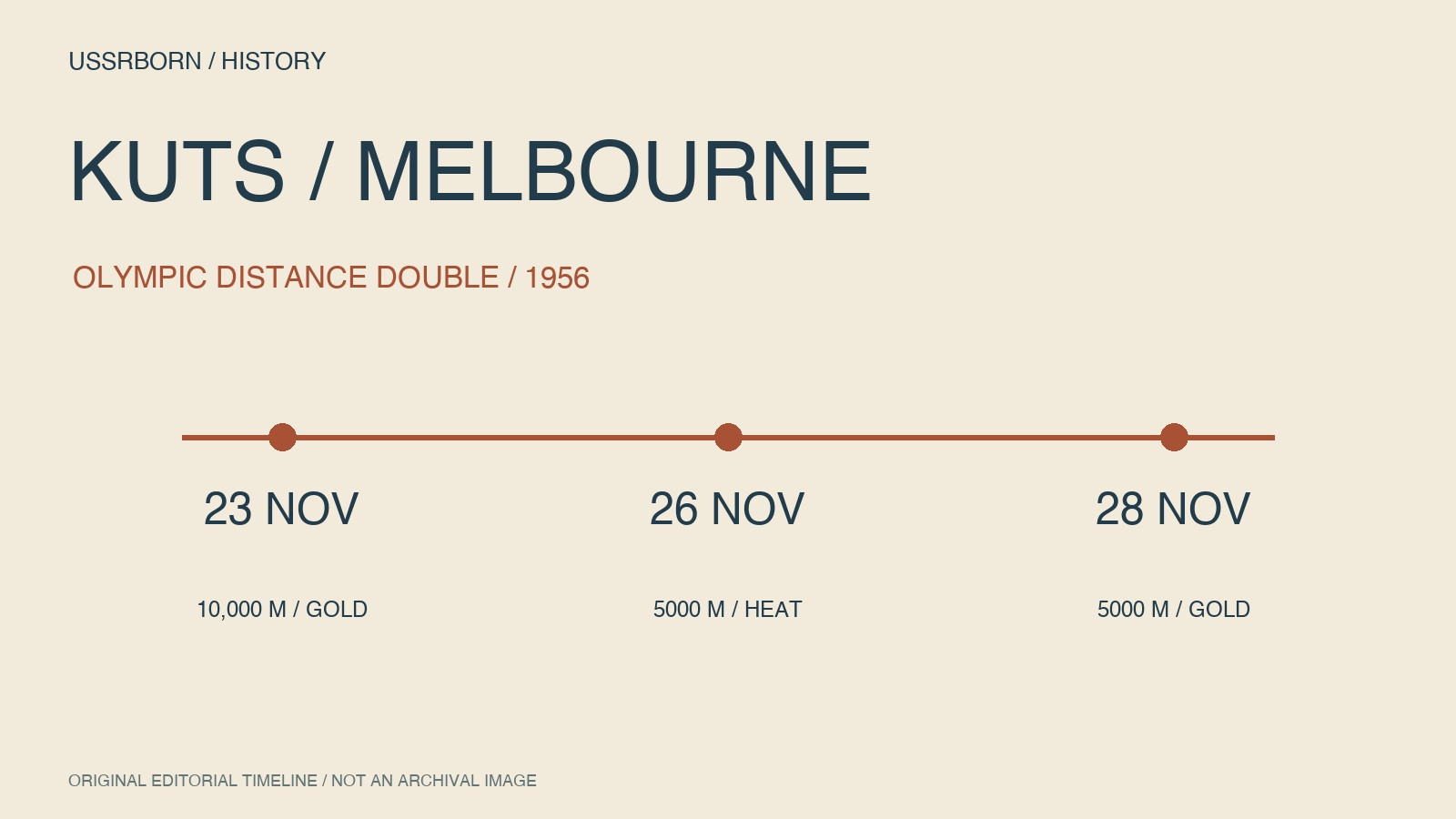
Vladimir Kuts won two distance titles at the Melbourne Olympics: the 10,000 metres on 23 November and the 5000 metres on 28 November 1956. Both victories produced Olympic records. The identical medal colour nevertheless conceals two different races, with a qualifying round for the shorter event between them.
An established contender before Melbourne
The Olympics did not introduce an unknown runner. Olympedia records that Kuts won both long-distance titles at the Soviet championships in 1953. In 1954 he became European 5000 metres champion with a world record of 13 minutes 56.6 seconds. His international standing was established before he travelled to Australia.
A record did not guarantee victory in the next encounter. Rivals could answer with faster performances or win a direct contest. That competitive setting makes the story more revealing than a list of honours: a record demonstrated an athlete's capacity, while a championship required that capacity to be realised in a particular race.
Kuts represented the Soviet Union in Melbourne. His Olympic participation was confined to the 1956 Games, where he won two gold medals. They belonged to two individual events, rather than a team classification or two stages of a single competition.
The 10,000 metres and control of pace
The 23 November event consisted of a final without qualifying heats. Kuts won in a hand-timed 28:45.6. Hungary's Jozsef Kovacs took silver in 28:52.4 and Australia's Al Lawrence bronze in 28:53.6. Britain's Gordon Pirie, a major rival, finished eighth.
Olympedia's account describes Kuts alternating surges with slower running in an effort to lose Pirie. The essential tactical point is the changing rhythm. A rival had to respond to variations in speed, rather than simply sustain one high average pace.
Distance running is not adequately described as continuous movement at a fixed rate. Athletes capable of similar performances in separate races can react differently when another runner determines the rhythm. Following each acceleration and maintaining one's own pace are different choices, with consequences that may become visible only later in the race.
Using the published hand times, Kuts finished 6.8 seconds ahead of Kovacs. That is the gap between first and second place. It should not be confused with the margin over Pirie, who occupied a different position in the final standings. A familiar account of a duel and the actual medal order are related, but they are not interchangeable.
A qualifying race between the two finals
The 5000 metres programme included heats on 26 November and the final on 28 November. Kuts advanced after finishing second in his heat in 14:15.4. Winning the qualifying race was not necessary to reach the final.
A second place in that part of the results therefore does not contradict his Olympic title. In a competition with several rounds, a result needs its stage attached. Qualification determines who progresses; the final determines the medals.
For the double, this also meant another competitive distance between the two gold-medal races. It cannot be removed from the schedule simply because it did not award a separate medal. The achievement was more demanding than two isolated final results suggest.
A second gold over 5000 metres
Kuts won the final in 13:39.6. Pirie took silver this time, recording 13:50.6, with Derek Ibbotson third in 13:54.4. The first-to-second gap was exactly 11 seconds on the hand times.
The changed order behind Kuts matters. Pirie recovered from eighth in the longer event to reach the podium in the shorter one. Kuts won both races, but the two contests should not be collapsed into a single story about one opponent's defeat.
The result also illustrates what a championship asks of a runner. It is a contest against the field present on that day. A successful strategy must produce the required placing, even when the resulting time differs from a record achieved elsewhere.
Olympic records are not the same as world records
An Olympic record concerns performances at the Games. A world record covers a broader set of recognised competitions. Winning an Olympic title with a Games record consequently does not require setting a new world record.
Kuts's best 10,000 metres performance was 28:30.4 in 1956, faster than his winning Melbourne time. Over 5000 metres, he ran 13:35.0 in Rome in 1957, after the Olympics. Those comparisons separate two objectives: winning a particular championship and producing the fastest possible recorded performance.
Historical results also sometimes display hand and automatic timing in adjacent columns. This article consistently uses the hand times, to tenths of a second, for the Olympic races. Mixing them with hundredths from another column would make calculations of margins inconsistent.
The distinction is especially useful when encountering a slightly different number in a reference work. Before treating it as an error, check which timing column the source uses and whether the result belongs to a heat or a final. These details explain more than a bare time can.
What the Melbourne double represents
Kuts's Melbourne success comprises two victories, two Olympic records and a qualifying race between the finals. It combines established ability with the demands of managing a competitive situation.
The results allow the achievement to stand without exaggeration. He did not need every appearance to become a world record. His decisive accomplishment was finishing first in two individual Olympic finals within the same Games.